WHERE THE MOUNTAIN MEETS THE SKY: Ideals Cast In Bronze, Granite, & Steel
Some things are built from the ground up. The Grand Block was a summit push.
There is a mountain in Wyoming that does not apologize for its height. It stands over Jackson Hole with its shoulders back, and it has stood that way since before there was a Jackson Hole to stand over. They call it the Grand.
There is a knife block in New West Knife Works that does not apologize either. We call it the Grand Block. The name was not an accident.
MAKING THE GRAND BLOCK
THE FIRST STEP UP
Every climb starts with a reason, and Erin Hemmings — the block's chief engineer and the man who has spent the better part of seven years pulling granite and metal into shapes they didn't ask to become — says this one started without a blueprint.
"I think the original concept wasn't really a design — it was really what could we do that would just blow people's minds, and really be a higher-end representation of the style that we've always kind of owned."
That's how you start up a mountain you've never climbed. Not with a map. With aspiration.
He knew the rock. Granite had always been in the New West vocabulary — cut, shaped, married to wood, made to hold knives and stop conversations. But bronze, poured against granite, at this scale — that was new ground.
"It was an idea that hadn't been done. Casting bronze — there's just something kind of timeless about it. On this block, I chose to let it be raw bronze... I really wanted to have that gold aspect. Raw bronze looks a lot like actual gold."
Gold, for a block named after a mountain that turns gold itself at sunrise.

THE ROCK DOESN'T CARE HOW HARD YOU WANTED IT
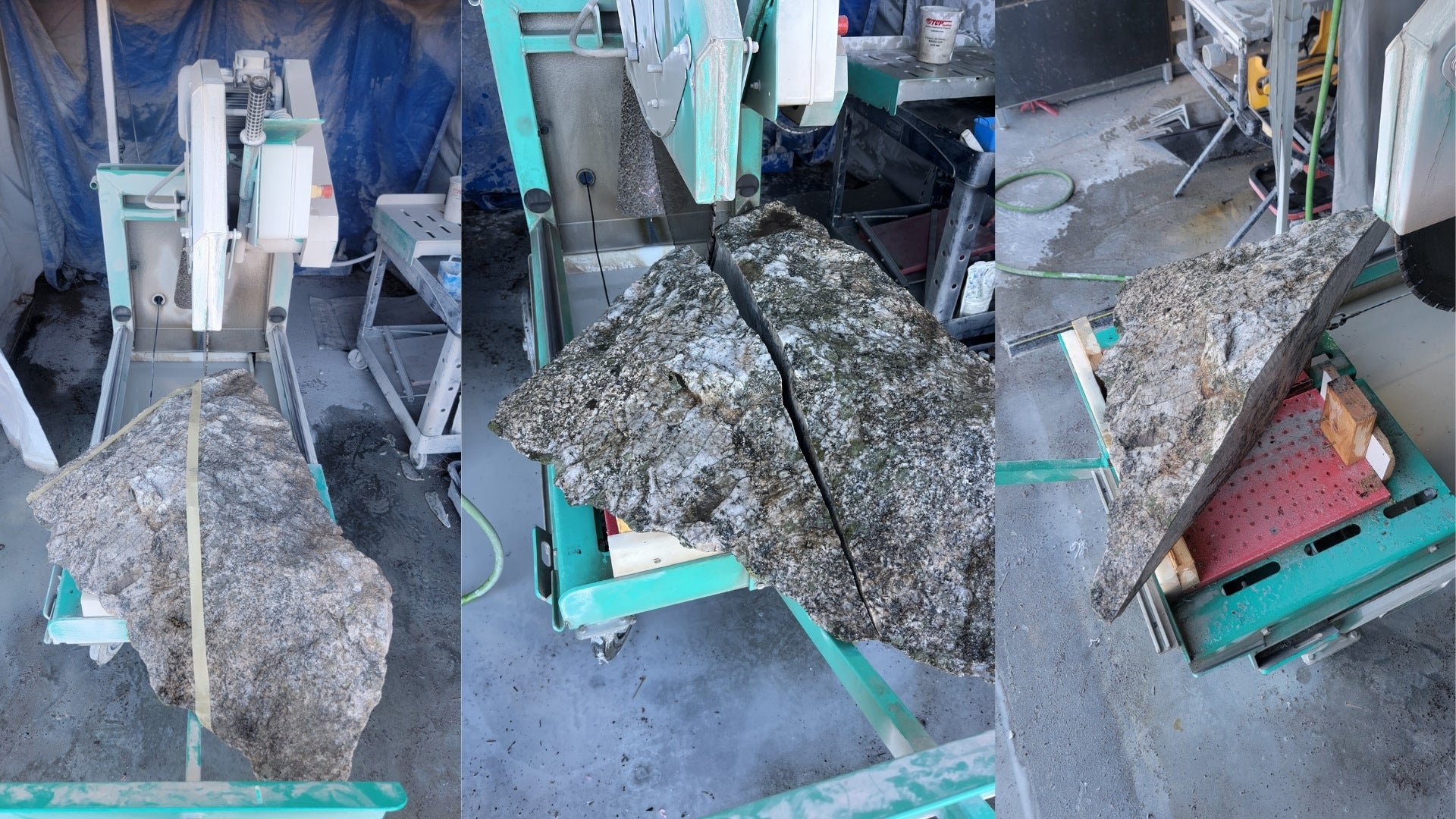
Every mountain has a section that humbles the climber. For the Grand Block, that was two hundred pounds of granite that had never met a knife block before.
"We have never cut a piece of granite this large. It started out as a piece of granite that was a couple hundred pounds... this rock could not [be cut in one go], so there was a lot of thought and design around the size and shape."
Hemmings wanted a live edge — a spine left raw, the way a mountain keeps its ridgeline raw — so the bronze could blend into it and the whole piece could be read from a single angle, front-on, everything visible at once.
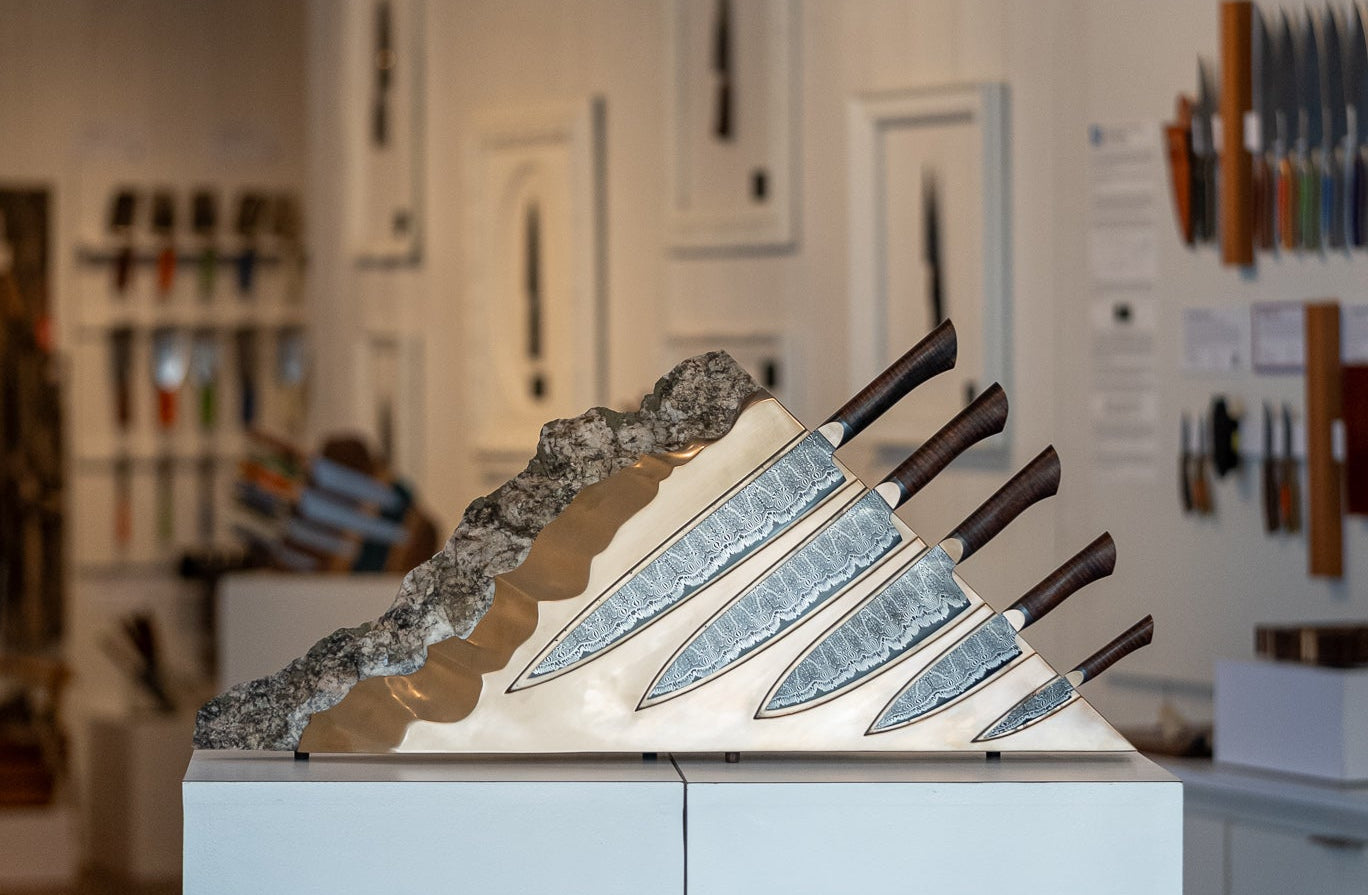
"I wanted to be able to look at the front of this block and see plenty of granite, see plenty of bronze, and see all of the knives... I really utilized the three-dimensionality of the granite and the live edge spine to achieve this effect."
He tipped the knife plane back, seven or eight degrees, so every blade leans the way a climber leans into a summit push.
"I tipped this plane back about seven, eight degrees so that kind of all sides of this Grand Block are angling up like a mountain would angle — so they're all kind of reaching toward that apex."
Reaching. That's the word for it. Everything about this block is reaching.
Bid on a One-of-One
This is where the climb ends — granite, gold-bronze, and Damascus steel, all reaching toward the same apex, all visible from one place if you stand in front of it and just look. There will never be another one made. The Grand Block goes to a single winning bidder, and bidding is open now.
THE FOUNDRY, AND FOUR FAILURES BEFORE THE FIFTH SUCCEEDED
No one climbs alone, not really. Somewhere behind every summit there's a partner holding the other end of the rope, and for Hemmings that partner was a foundry in Oregon willing to do something old the hard, new way.
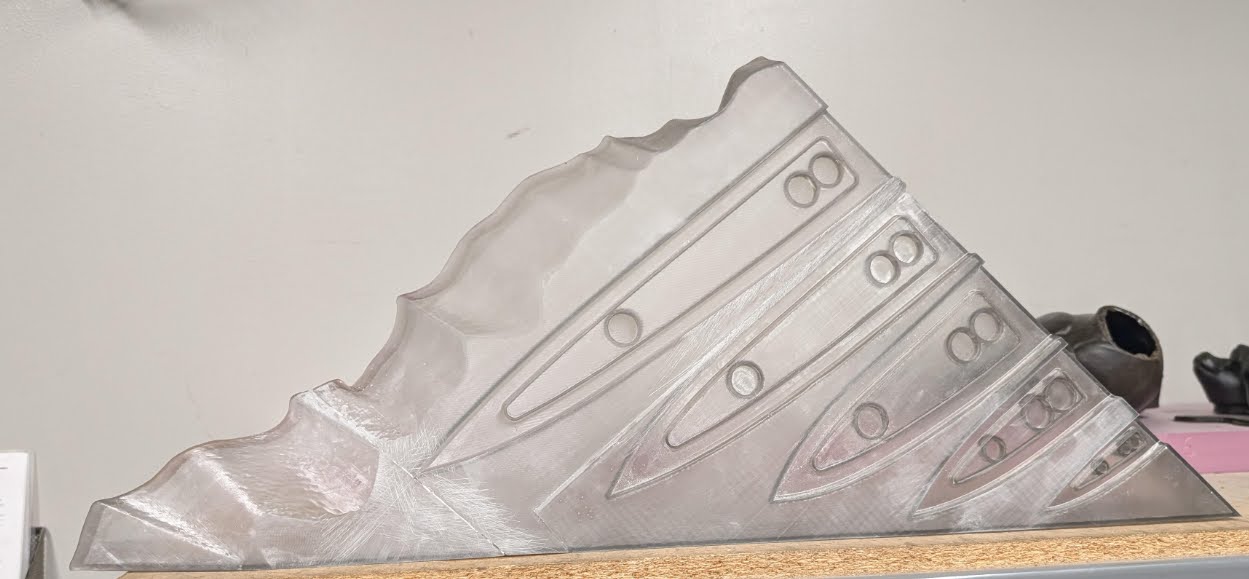
"Our shop is not really completely set up for bronze casting... so I did what I'm good at, which is using 3D CAD software to conceive of designs, and I found Firebird Foundry over in Oregon. They're kind of cutting edge."
The foundry took his file, printed an exact model in a filament built to burn away clean, and poured bronze into the void it left behind — the oldest trick in metalworking, run through the newest machine available for it.
It did not go well the first time. Or the second.
"It actually took them, I believe, four or five attempts to get the precision that we needed. We really needed flat planes — these knives cannot be on a curve — and they struggled with warpage and shrinkage."
A mountain does not care that you tried your best on the first attempt. It only cares whether you're still climbing on the fifth.
"They did a final casting- that is what you see before you. Came out really good."
Eight months, start to finish. Concepts even earlier than that.
"It's been a lot of back and forth and a lot of work to achieve what we ended up with, which I'm really pleased with."
TWO CLIMBERS, ONE ROPE
A mountain this size needed more than one person reaching for the top. Bladesmith Jack Rellstab had been forging mosaic Damascus knives at New West that Hemmings describes with something close to awe.
"It seems like the sky is the limit for what he's capable of doing."
The two didn't just decide to pair the block with Rellstab's knives. They shaped each other along the way up.
"His knives inspired Sarah and I in our pursuit of how to design this block, and as Jack watched the progression of the block design, I think he was also inspired... You can clearly see some relation between the profile and the sculpture of the block being represented in the pattern of his mosaic Damascus. They look like they're made for each other."
Because Rellstab's blades carry a more convex geometry than a standard kitchen knife, they wouldn't sit flat against a normal magnetic plane. So the block had to climb a little higher to meet them.
"We had to add more magnetic power to this block in order to hold all of the knives securely."
And between blade and bronze, a layer of ebony — not decoration, but protection, the kind of gear a good climber never skips.
"I wanted to protect the bronze, I wanted to protect Jack's knives, and so we put ebony between the bronze and the blades... that is the only contact surface."

THE VIEW FROM THE TOP LOOKS DIFFERENT THAN THE VIEW FROM BELOW
Somewhere in the last stretch, Hemmings changed his mind about the finish — and that, too, is a thing that happens near a summit, when you can finally see the whole shape of the thing you climbed.
"We originally went for a polished bronze look... but this bronze piece is actually welded together as three separate pieces, and you could kind of see [the seam]. So I went to a brushed finish, which I think makes it so you don't look at the little things. You look at the whole."
He left a gap between bronze and granite on purpose — not a flaw, a decision.
"I really like that there's a gap. I made a purposeful reveal between the bronze and the granite. It kind of creates a shadow line, and sometimes that's better than a flush finish."
Bolted, not glued. Built to outlast the man who built it.
"I have full faith that this block can last a very, very long time. The bronze isn't going anywhere, and neither is the granite."

THE SUMMIT
A mountain doesn't finish. It just waits for the next person willing to climb it.
The Grand Block took eight months, one foundry's fifth attempt, two makers' shared eye, and a bladesmith whose steel had already been climbing toward this shape before anyone drew it. What's left is granite and gold-bronze and Damascus steel, all reaching toward the same apex, all visible from one place if you stand in front of it and just look.
"The end result speaks for itself, and Jack's knives are also perfect for this block. I'm very jealous of whoever ends up owning this thing."
So is everyone who watched it get made.
Watch the video above to see the climb — from raw granite to finished summit.
Blog posts
View all-
Where the Mountain Meets the Sky: Ideals Cast i...
Some things are built from the ground up. The Grand Block was a summit push — eight months, four failed castings, and three makers reaching for the same apex. Here's...
Where the Mountain Meets the Sky: Ideals Cast i...
Some things are built from the ground up. The Grand Block was a summit push — eight months, four failed castings, and three makers reaching for the same apex. Here's...
Read More -
Shaped by the Snake River | The Story Behind Ne...
A kid from Ohio fell in love with moving water and never looked back. The story behind the Snake River Series — and the man who built New West KnifeWorks....
Shaped by the Snake River | The Story Behind Ne...
A kid from Ohio fell in love with moving water and never looked back. The story behind the Snake River Series — and the man who built New West KnifeWorks....
Read More -
Jack Rellstab's Custom Elk Antler Steak Knife Set
Forge-welded sanmai steel. Naturally shed Rocky Mountain elk antler, lapped flat on granite and pinned by hand. Journeyman Smith Jack Rellstab made six steak knives that will never be made...
Jack Rellstab's Custom Elk Antler Steak Knife Set
Forge-welded sanmai steel. Naturally shed Rocky Mountain elk antler, lapped flat on granite and pinned by hand. Journeyman Smith Jack Rellstab made six steak knives that will never be made...
Read More -
The Year of the MTN Man
"This is the Year of the MTN MAN," says founder Corey Milligan. "Hunting, fishing, skiing, cooking over fire, getting way out there… that's always been part of our DNA." New...
The Year of the MTN Man
"This is the Year of the MTN MAN," says founder Corey Milligan. "Hunting, fishing, skiing, cooking over fire, getting way out there… that's always been part of our DNA." New...
Read More