
Why Hand Finishing Matters: How We Make Kitchen Knives Feel Seamless


What “Hand Finished” Actually Means
“Hand finished” isn’t a marketing phrase. It’s a functional difference you can feel the first time you pick up the knife.
Every New West knife is:
- Assembled by a single maker
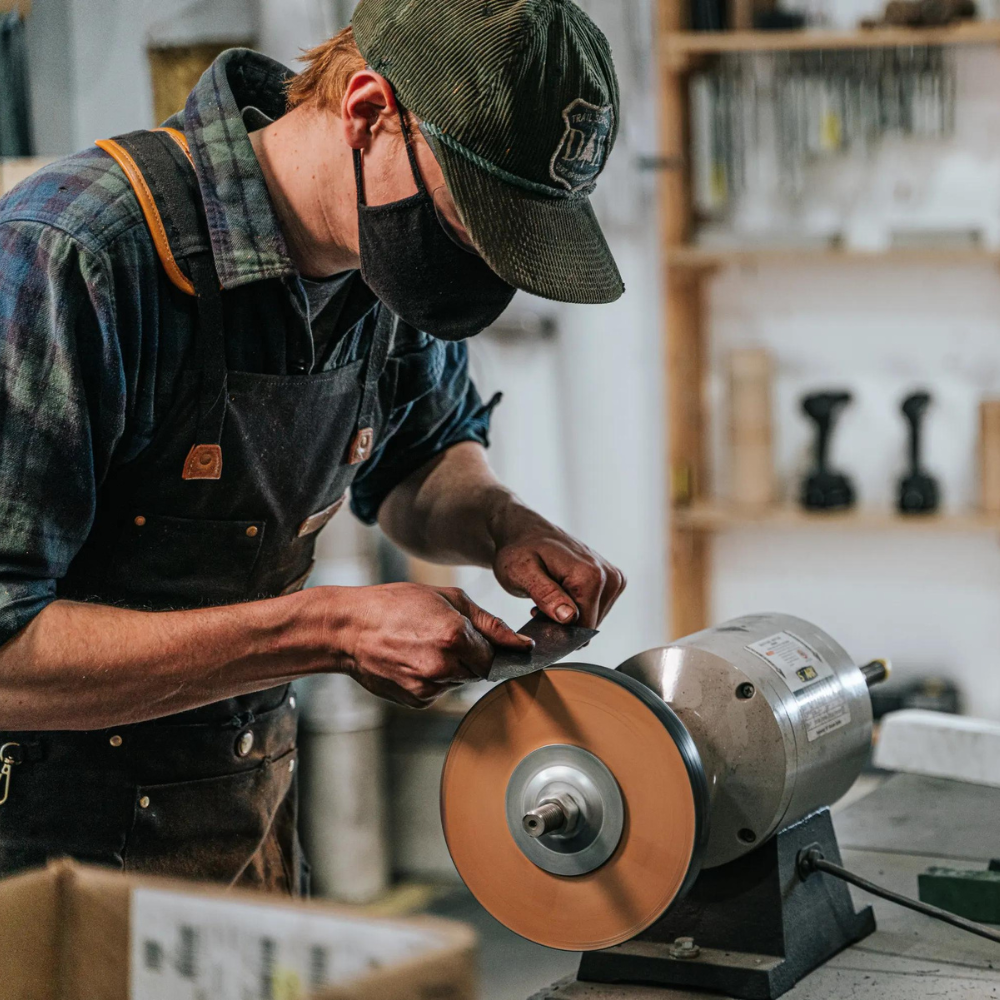
- Shaped and refined by hand
- Finished through multiple stages of grinding and polishing
This isn’t an assembly line. Each knife maker is responsible for completing a set number of knives to exacting quality standards—start to finish.
The result: every knife is slightly individual, but consistently excellent.
Why Machines Can’t Do This Step
Modern knife manufacturing relies heavily on precision machinery—and so do we.
We use:
- CNC machining for accuracy
- Precision grinding for blade geometry
But machines fall short in one critical area: fit and finish where the human hand meets the knife.
Subtle variations in:
- Grip style
- Hand position
- Pressure points
…require a level of adjustment that only a trained craftsman can deliver.

The Seamless Grip (Spine and Choil)
One of the most important—and most overlooked—details in a kitchen knife is the transition points: the spine and the choil.
Most mass-produced knives leave these areas with hard, sharp edges.
Over time, that creates:
- Friction
- Calluses
- Discomfort during extended use
We hand soften and round these areas so the knife feels smooth in a pinch grip—the way most chefs actually hold a knife.
This is the difference between a knife you tolerate and a knife you reach for every day.

Flush Rivets and Food Safety
A kitchen knife isn’t just a cutting tool—it’s part of a food-safe system.
That’s why we hand-finish every rivet so it sits perfectly flush with the handle.
Why it matters:
- No gaps or crevices for food to collect
- Easier cleaning
- Safer for professional kitchen environments
Many knives—especially those adapted from other categories—use fasteners that leave small pockets or recessed areas. Those can trap debris and moisture, creating sanitation issues over time.
We eliminate that entirely.

From Assembly to Seamless Finish
Every New West knife starts its final phase looking rough—by design.
During assembly, adhesive is intentionally applied in excess to fully seal the knife, ensuring no gaps, no moisture intrusion, and long-term durability. What begins as a “hot mess” is then refined entirely by hand.
Each knife moves through multiple stages:
- Excess epoxy and rivets are ground flush
- The handle is shaped and transitions are defined
- Surfaces are refined through progressive grits
- Every material is blended into a single, unified form
By the end, the blade, handle, and rivets no longer feel like separate parts—they feel like one continuous piece.

Finished by Hand, Built to Be Used
No part of the knife is left untouched.
Every surface is refined for comfort. Edges are softened where your hand meets the steel. The knife is hand sharpened, balanced, and brought to life by a single maker—not an assembly line.
You may not see every step of that process.
But you’ll feel it the moment you pick it up:
- In the seamless grip
- In the balance
- In the way the knife disappears in your hand
That’s what hand finishing delivers—and why it matters.


Blog posts
View all-

"This One's Mine": Chef Gator and the Knife He ...
People keep walking into our stores asking for a knife they saw at a dinner. It almost always belongs to Chef Gator. The man who feeds the Yellowstone set carries...
"This One's Mine": Chef Gator and the Knife He ...
People keep walking into our stores asking for a knife they saw at a dinner. It almost always belongs to Chef Gator. The man who feeds the Yellowstone set carries...
Read More -

Let Our People Go Skiing: A Knife Maker's Life ...
One of our six company tenets, brought to life: custom knife maker Arik Miller splits his time between the forge and the Snake River.
Let Our People Go Skiing: A Knife Maker's Life ...
One of our six company tenets, brought to life: custom knife maker Arik Miller splits his time between the forge and the Snake River.
Read More -

From the Valley to the Table: A Night for Slow ...
Our founder Corey Milligan and Chef Gator cooked for Slow Food in the Tetons. A recap of the dinner, the mission, and the knives that were in the room.
From the Valley to the Table: A Night for Slow ...
Our founder Corey Milligan and Chef Gator cooked for Slow Food in the Tetons. A recap of the dinner, the mission, and the knives that were in the room.
Read More -

Behind the Scenes: Inside a New West KnifeWorks...
Guests come to Victor to see knives. They leave having met the people who make them.
Behind the Scenes: Inside a New West KnifeWorks...
Guests come to Victor to see knives. They leave having met the people who make them.
Read More


